So, you’re ready to mix like a pro in 2026. That means skipping the clunky hand-stirring and finding a magnetic stir plate built for precision, heat, and durability.
We’ve lined up seven top-tier contenders, from compact 300 ml workhorses to 5-liter beasts with over-temperature shutoffs.
But before you pick your champion, you need to know which features actually matter.
At a Glance
- FOUR E’S offers precise heating up to 280°C with ±0.5°C accuracy.
- LVDALAB’s 3000 RPM brushless DC motor suits low-viscosity liquids up to 3000 ml.
- Slendor provides 180W heating and 2000 RPM stirring, operating 8 hours at medium speed.
- INTLLAB’s compact design includes 7 stir bars and retriever for small lab spaces.
- Safety features like over-temperature protection and hot warning indicators ensure reliable operation.
| FOUR E’S SCIENTIFIC 5 Inch Magnetic Stirrer Hot Plate | 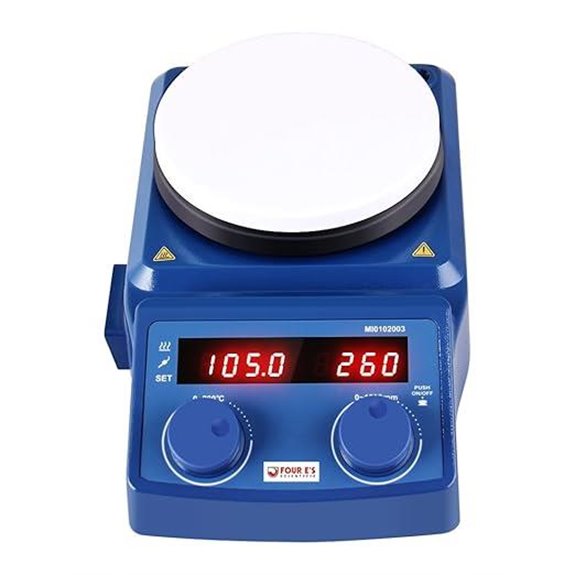 | Best High-Temperature | Max Stirring Speed: 1500 RPM | Max Stirring Capacity: 5L | Heating Capability: Yes (max 280°C) | VIEW LATEST PRICE | Read Our Analysis |
| LVDALAB 3000RPM Magnetic Stir Plate Yellow | 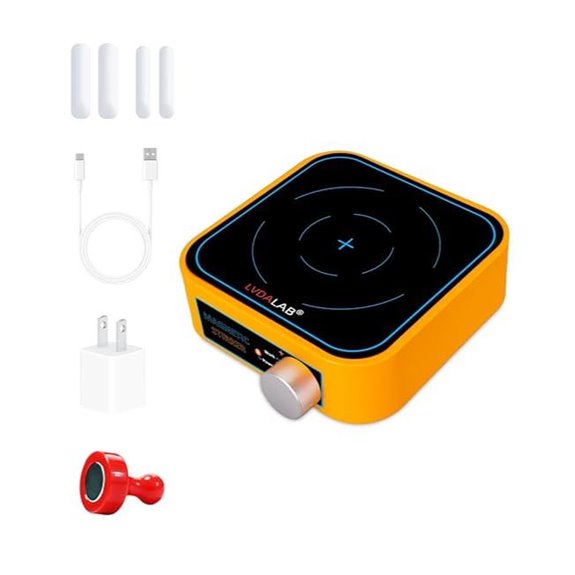 | Best Compact Design | Max Stirring Speed: 3000 RPM | Max Stirring Capacity: 3000 ml | Heating Capability: No | VIEW LATEST PRICE | Read Our Analysis |
| Magnetic Stirrer Hot Plate with Stir Bar | 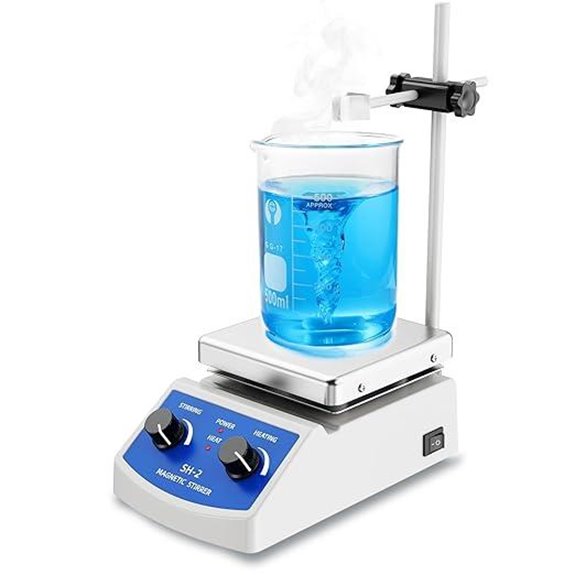 | Best Budget Companion | Max Stirring Speed: 2000 RPM | Max Stirring Capacity: 1000 ml | Heating Capability: Yes (max 520°F) | VIEW LATEST PRICE | Read Our Analysis |
| Slendor Magnetic Stirrer Hot Plate 520 | 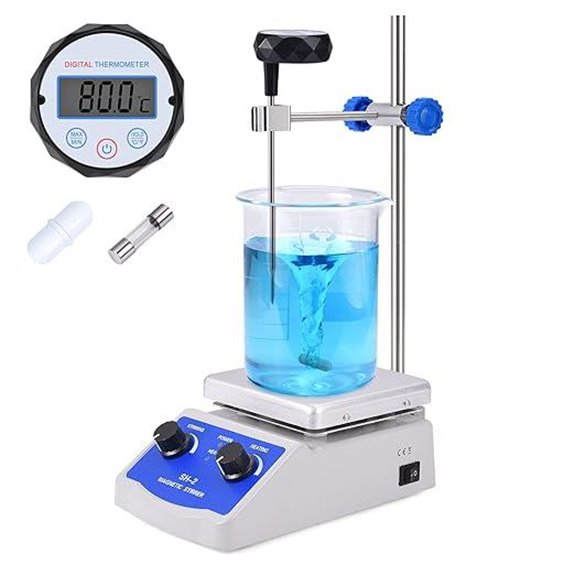 | Best Dual Function | Max Stirring Speed: 2000 RPM | Max Stirring Capacity: Not specified | Heating Capability: Yes (max 520°F) | VIEW LATEST PRICE | Read Our Analysis |
| INTLLAB Magnetic Stirrer with 7PCS stir bar Set and stir bar Retriever | 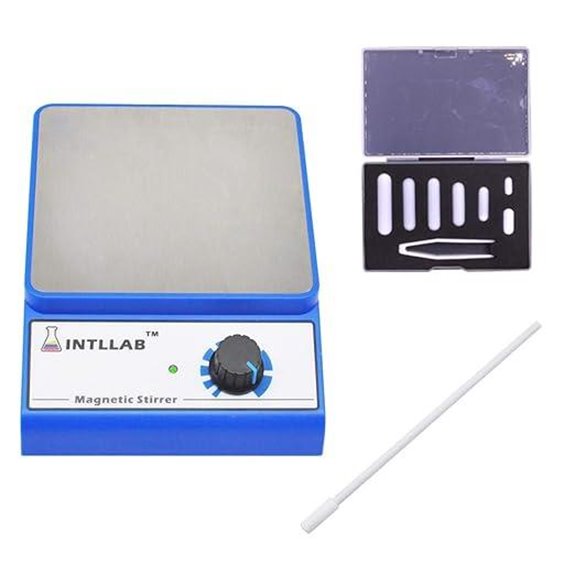 | Best Complete Kit | Max Stirring Speed: Not specified | Max Stirring Capacity: Not specified | Heating Capability: Not specified | VIEW LATEST PRICE | Read Our Analysis |
| 300℃ Magnetic Stirrer Hot Plate 2L | 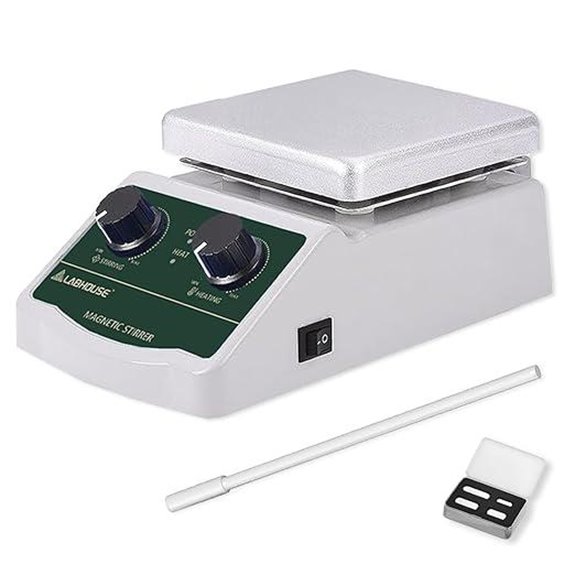 | Best Precision Control | Max Stirring Speed: 2000 RPM | Max Stirring Capacity: 2000 ml | Heating Capability: Yes (max 300°C) | VIEW LATEST PRICE | Read Our Analysis |
| Magnetic Stirrer with Digital Display & 4 Bars | 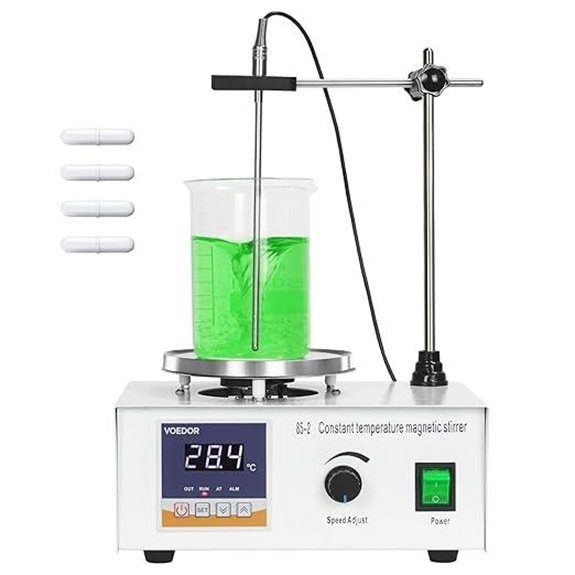 | Best Digital Display | Max Stirring Speed: 2000 RPM | Max Stirring Capacity: 1000 ml | Heating Capability: Yes (max 212°F) | VIEW LATEST PRICE | Read Our Analysis |
More Details on Our Top Picks
FOUR E’S SCIENTIFIC 5 Inch Magnetic Stirrer Hot Plate
For those who tackle serious thermal tasks—like home chemistry or high-volume brewing—this stir plate handles sustained high-temp mixing reliably. It reaches 280°C with ±0.5°C accuracy, thanks to its internal sensor and PT1000 probe.
The ceramic coating speeds cooling between batches, and the motor runs continuously for up to 168 hours. Safety is smartly covered: a hot warning at 50°C, splash protection, and high-temp cutoff. Use a glass lid with a cooling hole to speed heating, and keep room temps above 25°C for best performance. No fuss, just solid engineering for demanding jobs.
- Max Stirring Speed:1500 RPM
- Max Stirring Capacity:5L
- Heating Capability:Yes (max 280°C)
- Heating Plate Material:Ceramic coating
- Included Accessories:PT1000 temperature probe
- Speed Control Type:Adjustable (100-1500 RPM)
- Additional Feature:Hot warning at 50°C
- Additional Feature:168-hour continuous operation
- Additional Feature:PT1000 temperature probe
LVDALAB 3000RPM Magnetic Stir Plate Yellow
The LVDALAB 3000RPM Magnetic Stir Plate, Yellow is a standout mini stirrer for those who need compact mixing without the bulk. Its ABS shell is both waterproof and durable, making cleanup a breeze.
The brushless DC motor hits up to 3000 RPM, but remember: it’s for low-viscosity liquids only—think salad dressings, protein shakes, or coffee, not honey or resin.
Quick tips for best results:
- Use beakers with thin, flat, non-magnetic bases.
- Turn the twist knob clockwise to increase speed.
- No heating—just mixing.
At 3000 ml max capacity, this yellow workhorse fits nicely in small labs or kitchens.
- Max Stirring Speed:3000 RPM
- Max Stirring Capacity:3000 ml
- Heating Capability:No
- Heating Plate Material:ABS (no heating)
- Included Accessories:None specified
- Speed Control Type:Twist knob
- Additional Feature:Compact and lightweight
- Additional Feature:Waterproof ABS material
- Additional Feature:Brushless DC motor
Magnetic Stirrer Hot Plate with Stir Bar
A decent stir plate shouldn’t cost a fortune, and this model proves it. It offers a speed range of 100–2000rpm, plus 180W of heating power that can reach a blistering 520°F.
The aluminum construction provides quick, even heat conduction, while the high-temperature-resistant magnet guarantees stable stirring. But note: the heat knob adjusts power, not liquid temperature, so plan accordingly. It handles up to 1000mL, perfect for lab work. The package includes a stir bar, support stand, and fuse—everything you need to stir like a pro without breaking the bank.
- Max Stirring Speed:2000 RPM
- Max Stirring Capacity:1000 ml
- Heating Capability:Yes (max 520°F)
- Heating Plate Material:Aluminum
- Included Accessories:Stir bar, fuse, support stand
- Speed Control Type:Dual control knobs
- Additional Feature:High-temperature-resistant magnet
- Additional Feature:Heat knob adjusts power
- Additional Feature:Support stand included
Slendor Magnetic Stirrer Hot Plate 520
Scientists needing precise sample preparation will appreciate the Slendor Magnetic Stirrer Hot Plate 520. This model, the SH-2, pulls double duty by combining stirring with heating. Its 180W heating power pushes temperatures up to 520°F, while the stirrer can hit a brisk 2000 RPM.
Adjusting speed is simple: a bottom control lets you turn clockwise to increase, counterclockwise to decrease. For longer experiments, note its stamina—4 hours at high speed, 8 hours at medium. It comes with a 1-inch Teflon coated stir bar and a thermometer for monitoring heat.
Built from advanced materials, it resists heat, wear, and chemicals. And each unit passes strict inspection. Whether for lab work or university research, it’s a solid, no-nonsense tool. Contact the seller with any questions.
- Max Stirring Speed:2000 RPM
- Max Stirring Capacity:Not specified
- Heating Capability:Yes (max 520°F)
- Heating Plate Material:Advanced high-temp material
- Included Accessories:1-inch Teflon stir bar, thermometer
- Speed Control Type:Bottom device knob
- Additional Feature:Bottom device speed regulation
- Additional Feature:1-inch Teflon stir bar
- Additional Feature:Thermometer for temperature display
INTLLAB Magnetic Stirrer with 7PCS stir bar Set and stir bar Retriever
This kit bundles everything needed to start stirring right away. The INTLLAB MS-500P-SET includes seven stir bars and a handy retriever, making it a complete starter package.
It weighs just 1.32 pounds with compact dimensions of 10.51 x 6.46 x 2.76 inches, perfect for cramped lab spaces. The stir bars come in various sizes, so you can match the bar to your beaker. Plus, the retriever simplifies removal—no more fishing around with tweezers. It’s a practical, no-nonsense setup.
- Max Stirring Speed:Not specified
- Max Stirring Capacity:Not specified
- Heating Capability:Not specified
- Heating Plate Material:Not specified
- Included Accessories:7 stir bars, stir bar retriever
- Speed Control Type:Not specified
- Additional Feature:7-piece stir bar set
- Additional Feature:Stir bar retriever included
- Additional Feature:Subcategory rank: 4
300℃ Magnetic Stirrer Hot Plate 2L
For those who need precise control over both heating and stirring in a single compact unit, the 300℃ Magnetic Stirrer Hot Plate 2L delivers reliable dual-knob adjustment for fine-tuned experiments.
Temperature adjustment goes up to 300°C, while mixing speed hits 2000 RPM—enough for most 2L batches. The aluminum plate heats fast and evenly, resisting corrosion. It comes with PTFE-coated stirring rods and a bar retriever.
Safety is built in:
- Independent over-temperature protection prevents overheating
- PTFE coating resists chemical damage
Just remember: don’t touch the plate until it cools. That burn is entirely avoidable. Ideal for labs, classrooms, or industrial mixing.
- Max Stirring Speed:2000 RPM
- Max Stirring Capacity:2000 ml
- Heating Capability:Yes (max 300°C)
- Heating Plate Material:Aluminum
- Included Accessories:PTFE stir rods, bar recycler
- Speed Control Type:Dual control knobs
- Additional Feature:PTFE-coated stirring rods
- Additional Feature:Bar recycler included
- Additional Feature:Independent over-temperature circuit
Magnetic Stirrer with Digital Display & 4 Bars
Laboratory users seeking a clear, real-time view of temperature and stirring speed will appreciate the 85-2 Digital Display Magnetic Stirrer. This model handles up to 1000 ml with a 0-2000 RPM range, thanks to a robust motor and stepless speed control.
Heating is quick and even, reaching 212°F/100℃ via a 250W element and 304 stainless steel plate. A built-in fuse protects against voltage overload, while non-skid foot pads keep things steady. Plus, it includes four magnetic stir bars for long-term use.
It’s versatile for labs, education, or cosmetics—just avoid high-viscosity liquids. The adjustable support rod lets you place the temperature probe precisely. Practical. Reliable. Ready to work.
- Max Stirring Speed:2000 RPM
- Max Stirring Capacity:1000 ml
- Heating Capability:Yes (max 212°F)
- Heating Plate Material:304 stainless steel
- Included Accessories:4 stir bars, temperature probe
- Speed Control Type:Stepless speed control
- Additional Feature:LED digital display
- Additional Feature:304 stainless steel plate
- Additional Feature:Adjustable support rod
Factors to Consider When Choosing Stir Plates
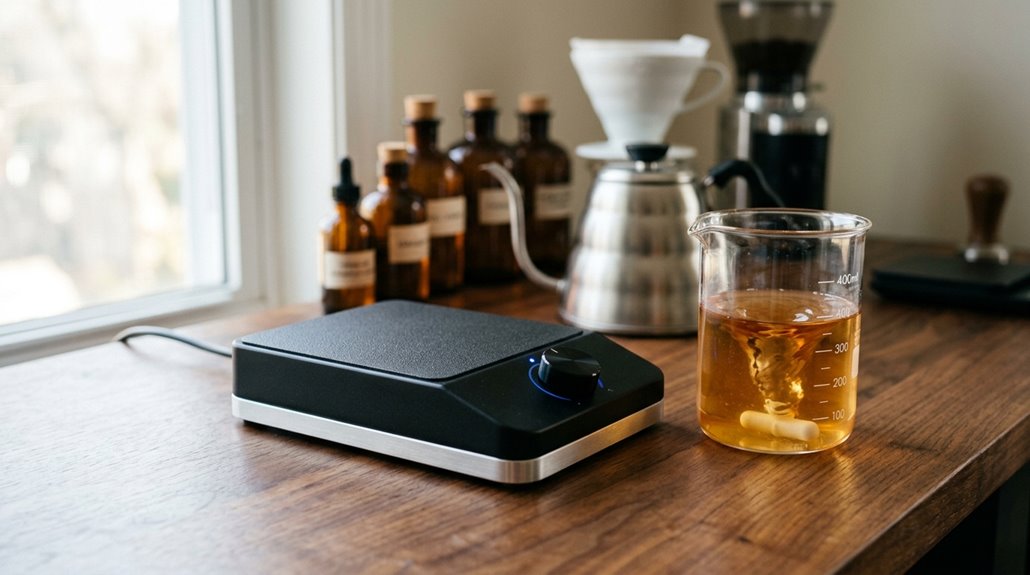
Speed range matters for precise mixing, especially with viscous fluids or delicate samples. But temperature control and heating capability are equally critical if experiments require heat, and safety features like overheat protection can prevent accidents.
Stirring capacity also sets the limits on volume, so matching it to the vessel size is a practical must.
Speed Range
The specific speed range of a stir plate is like the engine’s horsepower in a car, it defines what you can realistically tackle. These plates typically span from 100 RPM to 3000 RPM, but you don’t always need that top end. Higher speeds (think 1500+ RPM) efficiently whip low-viscosity liquids into a vortex, perfect for quick chemical reactions. Lower speeds, around 100 to 500 RPM, are gentler, ideal for delicate materials that can’t take a beating.
Adjustable settings give you precise control, so you can fine-tune for each experiment. A consistent speed is key for uniform mixing, directly influencing reaction rates. But watch out: larger volumes may need lower speeds to stay stable and avoid splashing. Always match the speed to your container size and material, pushing too fast just makes a mess.
Temperature Control
Of course. Temperature control is where precision meets safety. For sensitive experiments, a variation of just ±0.5°C can be the difference between success and frustration, so look for that accuracy.
Integrated sensors, like PT1000 probes, greatly boost reliability during heating. And don’t overlook the heating surface itself: ceramic or aluminum options improve thermal conductivity, providing quicker, more uniform temperature distribution.
But safety must come first. Essential features include over-temperature protection to prevent overheating and hazards during operation. A well-designed stir plate manages heat with control and caution.
- Aim for ±0.5°C accuracy for sensitive work.
- Check for PT1000 sensor integration.
- Prefer ceramic or aluminum heating surfaces.
- Verify over-temperature protection is built-in.
Heating Capability
When examining heating capability, you’ll want to contemplate the maximum temperature a model can achieve, some reach up to 280°C (536°F), which is plenty for boiling water or heating oils. But heating isn’t just about the ceiling; accuracy matters too. Look for a unit that maintains temperature within ±0.5°C, so you don’t overshoot your target or struggle with inconsistent results.
Heating power ranges from 180W to 600W, directly impacting how fast your liquid warms up, wattage matters if you’re impatient or working with larger volumes. A dual control design is a game-changer here, letting you tweak stirring speed and temperature independently. This means you can boost heat without accidentally spinning your beaker into a frenzy. For instance, a 500W plate paired with precise control handles everything from delicate enzymes to thick slurries. Always check the wattage and accuracy specs before buying.
Safety Features
Several important safety features can make or break your experience with a stir plate. First, look for built-in over-temperature protection—it automatically shuts off the hotplate to prevent overheating, which is a lifesaver during long experiments. Many models also include hot warning indicators; these brightly light up when the surface exceeds a safe threshold, keeping you from burning yourself.
But safety doesn’t stop there. Stirring splash protection is a subtle hero, containing liquids to reduce spill risks. And for stability, non-skid foot pads grip the bench, preventing movement that could topple your beaker. Maintenance-free motors run continuously without fuss, minimizing the need for intervention. These features might seem small, but they collectively keep your lab sessions smooth, safe, and surprisingly headache-free.
Stirring Capacity
The heart of any stir plate lies in its stirring capacity, the maximum volume it can reliably mix. This spec can range from a modest 300 ml for smaller units to 5 liters or more on heavy-duty models. Higher capacities demand stronger motors and sturdier mechanisms to keep things moving smoothly.
But capacity isn’t just about volume. Consider the liquid’s viscosity; some plates handle thick sludges, while others prefer thin broths. A mismatch means incomplete mixing or a sluggish stir, especially frustrating in larger experiments.
To choose wisely:
- Match the capacity to your typical batch size.
- Account for thicker mixtures needing more torque.
- Check if precise control matters for your tasks.
Frequently Asked Questions
Can I Use the Stir Plate for Non-Laboratory Applications?
Absolutely. A stir plate excels at any task requiring gentle, consistent mixing. For the home bar, it’s perfect for dissolving simple syrup or aerating a stirred cocktail. Homebrewers can use it to rehydrate yeast, though the small volume is limiting for full batches.
In the kitchen, it can hold a stable temperature for delicate sauces or chocolate tempering. The key is matching the vessel size and stir bar to the application.
How Do I Clean the Stir Plate Without Damaging It?
Unplug it first, always. Wipe the stainless steel top with a damp, lint-free cloth and mild soap; never submerge it. Use a cotton swab dipped in isopropyl alcohol for stubborn gunk around the stir bar or vent.
Dry immediately, moisture is the enemy of the internal motor. For the base, just a quick, dry dust. And if liquid spills inside? Let it dry completely for 48 hours before testing.
Will the Stir Plate Work With Thick Liquids Like Honey?
Most standard stir plates will struggle with honey’s extreme viscosity. A magnetic stir bar simply cannot spin in such thick liquid without stalling. However, a high-torque model (often called a “heavy duty” stir plate) can handle it if you first warm the honey slightly. Aim for 100°F; this thins it enough for the bar to spin.
And never start at maximum speed, ramp up slowly to avoid flinging the bar. Check the manufacturer’s torque specifications before purchasing!
What Is the Maximum Volume of Liquid These Plates Can Handle?
Maximum volume typically maxes out at 5 liters, though common models comfortably handle 1 to 3 liters. A short punch: bigger batches need stronger magnets and motors. For thick honey, capacity drops sharply, expect around 500 milliliters to stay effective.
And when scaling up, watch for vortex stability; a wide, flat vessel works better than a tall one. Start small, test thoroughly.
How Long Is the Typical Lifespan of a Stir Plate Motor?
The lifespan of a stir plate motor typically spans 5 to 10 years with regular use. This depends heavily on build quality; a cheap, sleeve-bearing motor might sputter out after 18 months of daily mixing. But a quality unit with a brushless DC motor, sealed from dust and drips, often hums along reliably for a decade.
Keep it clean, avoid overloading with heavy volumes, and let it rest between long sessions. Even a pro can’t outrun basic wear and tear, but a wise choice up front pays off handsomely over time.